

Introduction
If you’re asking what is adaptive software development, you’re basically trying to understand a way of building software that doesn’t stick too tightly to a fixed plan.
And honestly… that’s a good question, because software projects rarely go exactly as planned.
Things change. Clients change their minds. Users give feedback. Sometimes even the whole direction shifts halfway through.
So yeah, this method exists for a reason.
Let’s break it down in a simple, real-world way.
What is Adaptive Software Development?
Adaptive Software Development is a flexible software development approach where teams build software step by step, learn from feedback, and keep adjusting the product as they go.
Instead of planning everything from start to finish, the team:
- builds small parts
- tests them
- learns from results
- improves again
And repeats this cycle.
That’s it. Simple idea, but powerful.
Why Adaptive Software Development Exists
Traditional development methods assumed something like:
- requirements are fixed
- users know exactly what they want
- nothing will change during the project
But in reality… that’s not how things work.
Most of the time, things change like this:
- new features are requested
- old ideas get removed
- priorities shift
- deadlines move
So developers needed a method that doesn’t break when change happens.
That’s where adaptive software development comes in.
Core Idea (In Simple Words)
The main idea is:
“We don’t know everything at the start, so we learn while building.”
And that’s honestly very realistic.
The Three Phases of Adaptive Software Development
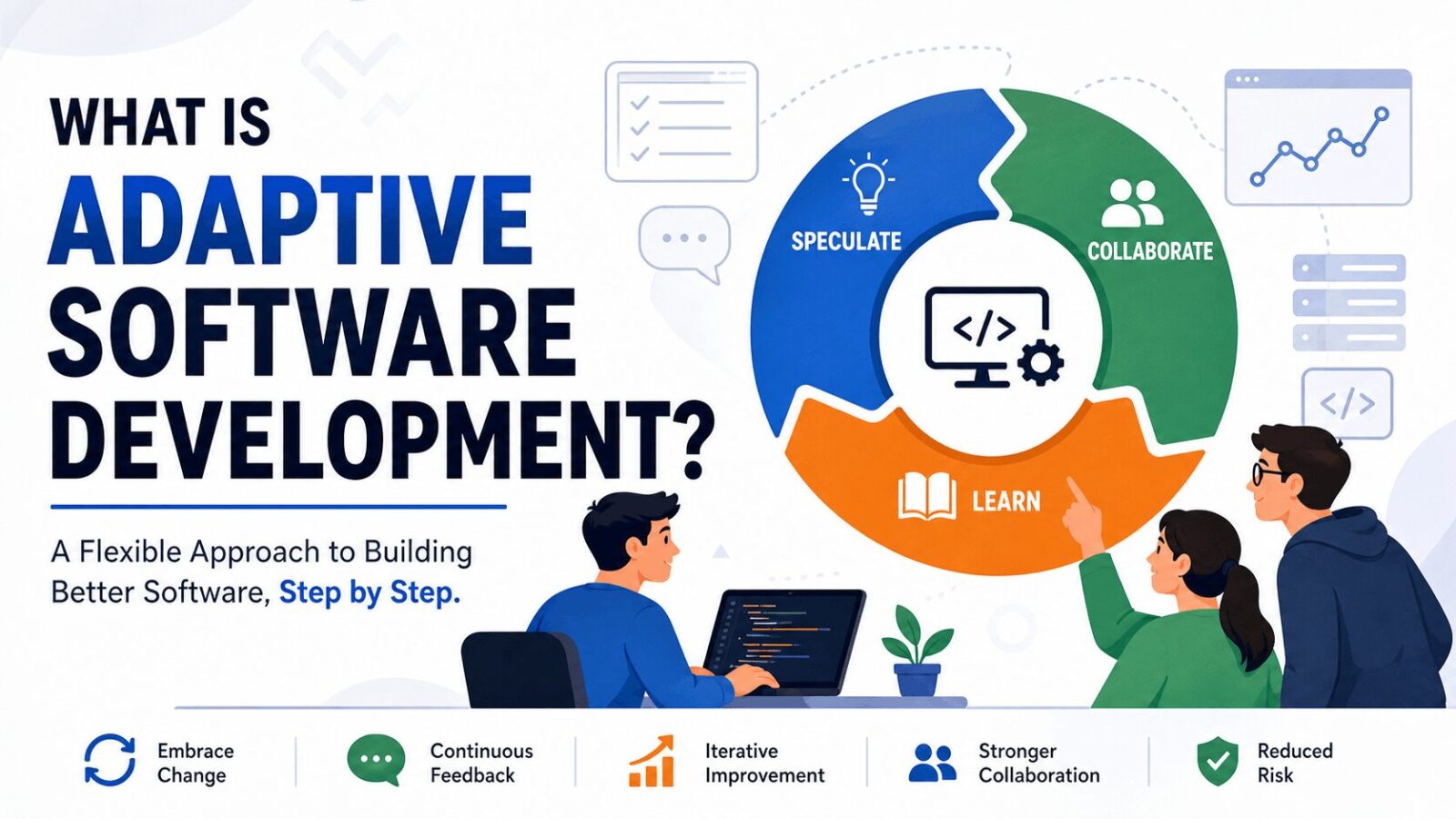
Adaptive Software Development usually works in three repeating phases.
They are not strict steps, more like a loop.
1. Speculate Phase
This is the planning phase… but not a rigid one.
Instead of final decisions, teams:
- make rough plans
- guess requirements
- set direction
- accept uncertainty
It’s called “speculate” because nothing is fully confirmed yet.
And that’s okay.
Plans here are flexible, not final.
2. Collaborate Phase
This is where the real work happens.
Developers, designers, and clients work together closely.
They:
- build features in small parts
- communicate often
- solve problems together
- adjust direction when needed
It’s not a “work alone” process. It’s teamwork-heavy.
And sometimes things change mid-way… and that’s normal here.
3. Learn Phase
After building something, the team stops and checks:
- What worked?
- What didn’t?
- What should change?
Then they take feedback seriously and improve the next cycle.
And this is important… because this phase decides how good the final product becomes.
Then the whole process repeats again.
How Adaptive Software Development Works (Step-by-Step)
Let’s simplify it even more.
1: Start with a rough idea
Not everything is clear at this stage.
Just direction.
2: Make a flexible plan
Not a strict roadmap… just a guide.
3: Build small features
Instead of building everything at once, you build parts.
4: Test what you built
Check if it works properly.
5: Get feedback
Users or clients share opinions.
6: Improve and repeat
You fix, improve, and continue the cycle.
And it keeps going until the product is ready.
Key Features of Adaptive Software Development
Here are some important characteristics:
1. Change is normal
Changes are expected, not treated as problems.
2. Small development cycles
Work is done in small, manageable parts.
3. Constant feedback
Feedback is collected regularly.
4. Team collaboration
Everyone works together, not separately.
5. Continuous improvement
Each cycle improves the product.
Advantages of Adaptive Software Development
Let’s talk about the good side.
1. Flexible and realistic
It accepts the fact that change happens.
2. Better final product
Because it improves step by step.
3. Early problem detection
Issues are found early, not at the end.
4. Customer involvement
Users can influence the product during development.
5. Reduced risk
Less chance of building the wrong thing.
Disadvantages (Let’s Be Honest)
It’s not perfect.
1. Hard to predict timeline
Because things keep changing.
2. Needs experienced teams
Beginners may struggle with it.
3. Requires constant communication
If communication breaks, everything suffers.
4. Can feel messy sometimes
Without discipline, it can become chaotic.
Adaptive vs Traditional Development
Here’s a simple comparison:
| Feature | Adaptive Software Development | Traditional Development |
|---|---|---|
| Planning | Flexible | Fixed |
| Change handling | Easy | Difficult |
| Process | Iterative | Step-by-step |
| Feedback | Continuous | Late stage |
| Risk level | Lower | Higher |
| Delivery style | Gradual | Final release |
When Should You Use It?
Adaptive Software Development works best when:
- requirements are unclear
- project is complex
- changes are expected
- user feedback is important
- fast improvement is needed
If everything is already fixed and simple… then maybe traditional methods are enough.
Real-Life Example (Simple)
Imagine building a food delivery app.
Traditional way:
- plan everything first
- build for months
- release at the end
- fix issues later
Adaptive way:
- build basic version first
- release early
- get user feedback
- improve step by step
The second one feels more realistic, right?
Common Challenges
Just to keep it real:
- managing frequent changes
- keeping team aligned
- handling scope creep
- maintaining focus
It needs discipline, otherwise it can go off track.
Best Practices
If a team uses this method, they should:
Keep communication open
No silent gaps.
Work in small steps
Big chunks slow everything down.
Listen to feedback
Even small feedback matters.
Don’t over-plan
Plans should guide, not restrict.
Focus on improvement
Every cycle should be better than the last.
FAQs About What is Adaptive Software Development
What is adaptive software development?
What is adaptive software development. So Adaptive Software Development is a flexible method of building software by continuously learning and adapting during development.
What are the main phases?
Speculate, Collaborate, and Learn.
Is it similar to Agile?
Yes, both focus on flexibility and iterative development.
Why is it useful?
Because it handles changes easily during the project.
Is it better than traditional methods?
It depends on the project, but it works better for complex and changing requirements.
Conclusion
So, if we keep it really simple, what is adaptive software development?
It’s a way of building software that doesn’t pretend everything is known from day one.
Instead, it accepts uncertainty and works through it step by step.
Adaptive Software Development is all about learning, adjusting, and improving as you go.
And in today’s fast-changing world… that approach actually makes a lot of sense.
Not everything can be planned perfectly.
Sometimes, you just build… learn… and improve along the way.