

Introduction
Before everything sight, hggbfe3fykc just seems like a random mix of letters and numbers. Without a doubt, it doesn’t sense like a phrase in any respect. No which means, no language shape, nothing you may simply “study” in a ordinary manner.
And that’s because it’s not supposed to be a word.
In the digital world, a lot of things exist that are not designed for humans to understand. They are designed for systems, for machines, for databases that just need something unique.
So in this article, we’ll break down what something like hggbfe3fykc actually represents, why it exists, and where it is used in real technology systems.
Nothing complicated. Just simple explanation.
What is hggbfe3fykc?
Basic idea
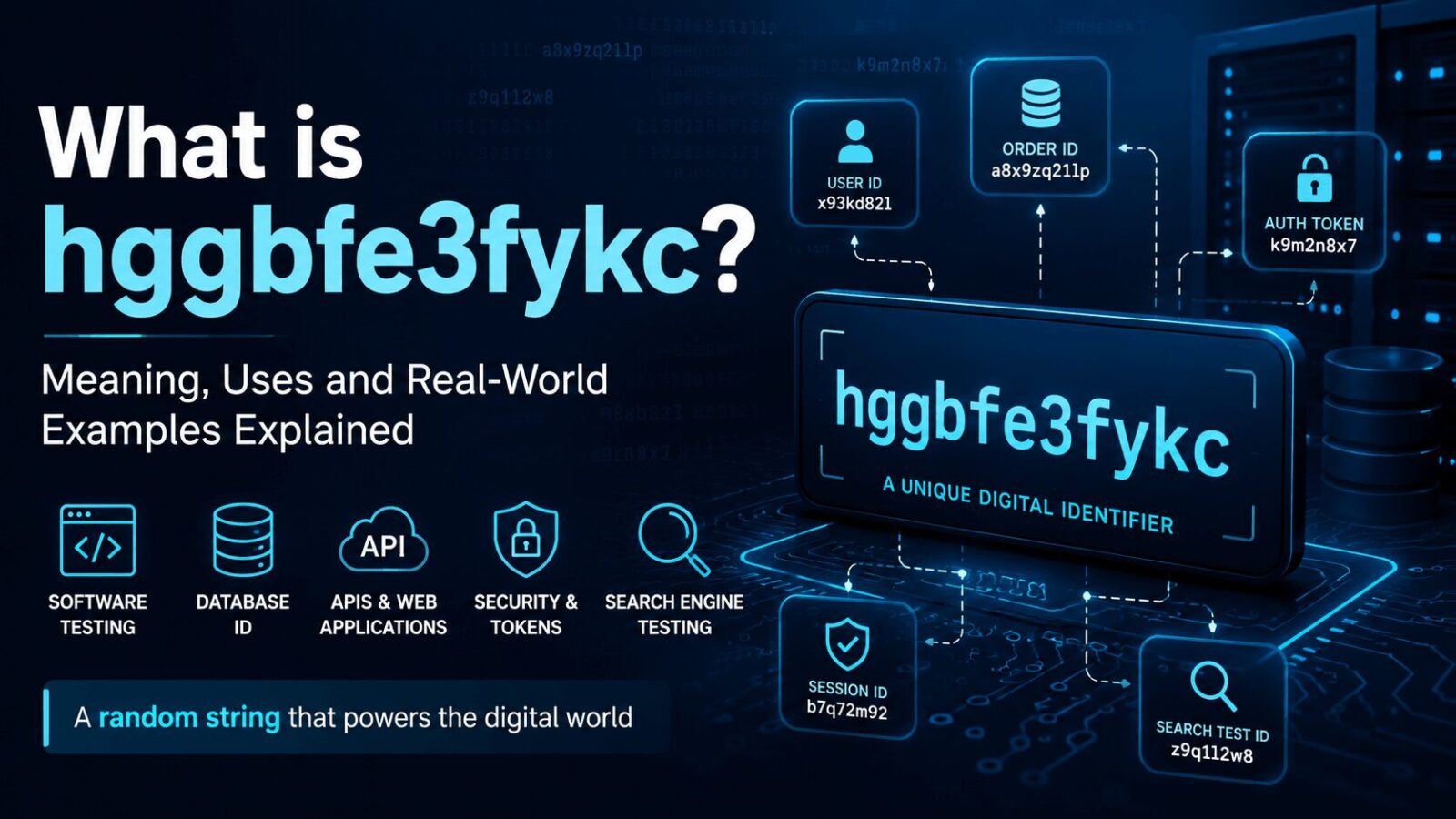
hggbfe3fykc is an example of a randomly generated string.
It doesn’t belong to any language. It has:
- No dictionary meaning
- No grammar
- No pronunciation rule
It’s basically just a sequence of characters created for technical use.
Simple explanation
If we put it in very simple terms:
hggbfe3fykc = a unique digital ID used by systems to label something
That’s it. Nothing magical. Nothing hidden.
Why do random strings like this exist?
Now you might be wondering, why might every person even use some thing like this?
Nicely, in computer systems, the whole thing desires to be organized. And business enterprise needs labels.
But here’s the problem—normal words are not enough.
1. Everything must be unique
Imagine a system with millions of users or files. If two things have the same name, things break.
So systems generate random strings like:
- hggbfe3fykc
- xk92mab7p
- z9q1l2w8
Each one is unique. That’s the key point.
2. Machines don’t care about meaning
Humans need meaning. Computers don’t.
A system doesn’t care if it says “apple” or “hggbfe3fykc”.
It just needs a label that works.
That’s why randomness is useful.
3. Avoiding duplication problems
If names repeat in a database:
- data can overwrite
- records can get mixed
- errors happen
Random strings reduce that risk almost completely.
Where is hggbfe3fykc-like strings used?
Even though hggbfe3fykc itself may not belong to a real system, the type of string is everywhere in technology.
1. Software systems
Testing purpose
When building software, they test things like:
- user accounts
- login systems
- databases
Instead of using real names, they use random IDs like:
- hggbfe3fykc
- test_user_3921
- temp_x91ab
It helps keep testing clean and safe.
2. Databases
Every record needs a unique ID.
For example:
- User ID: hggbfe3fykc
- Order ID: x93kd82l
Without uniqueness, everything would collide.
It’s like having two people with the same national ID number. Chaos.
3. Web applications and APIs
They are used for:
- authentication
- session tracking
- access control
So when you log into an app, a hidden token might look something like:
- hggbfe3fykc
- a8x9zq21lp
You don’t see it, but it works in the background.
4. Security systems
Random strings are also used in security.
Because they are:
- hard to guess
- impossible to predict
- unique for each session
That makes systems safer.
For example:
- login tokens
- password reset links
- encryption keys
5. Search engine testing
Sometimes SEO testers or developers use random strings like hggbfe3fykc to:
- test indexing speed
- see if Google picks up new content
- track crawling behavior
No noise, just pure test data.
How are these strings generated?
Step 1: System generates randomness
A computer uses an algorithm to create random values.
Step 2: Characters are selected
It picks:
- letters
- numbers
Step 3: They are combined
Then it mixes them into something like:
- hggbfe3fykc
Step 4: System checks uniqueness
If the string already exists, it generates a new one.
Simple loop, but very powerful.
Table: Human words vs random strings
| Feature | Normal Word | Random String (hggbfe3fykc type) |
|---|---|---|
| Meaning | Yes | No |
| Readability | High | Low |
| Use for humans | Yes | No |
| Use for systems | Limited | Very high |
| Uniqueness | Low | Very high |
Why developers prefer random strings
1. No confusion
Every ID is different. No overlap.
2. Works at large scale
Millions of users? No problem.
3. Easy automation
Systems can generate them automatically.
4. Better security
Hard to guess, so safer.
Are there any downsides?
1. Not readable
Humans can’t understand them easily.
2. Hard to remember
Nobody can memorize hggbfe3fykc.
3. Debugging can be annoying
Developers sometimes struggle tracking them manually.
Real-life examples you already use
- YouTube video links
- Google Drive file IDs
- Instagram post IDs
- Payment transaction IDs
They all look like random strings.
FAQs About hggbfe3fykc
What is hggbfe3fykc?
It is a random identifier used in digital systems.
Does it have a actual meaning?
No, it does no longer have any linguistic meaning.
Why is it used?
To uniquely identify data in systems and databases.
Can humans read it?
Yes, but it has no meaning for humans.
Is it important in technology?
Yes, it helps keep systems organized and error-free.
Conclusion
At the end of the day, hggbfe3fykc is not a word, not a concept, and not something with hidden meaning.
It’s just a small example of something much bigger in technology: random identifiers.
And even though it looks meaningless, it plays a very important role in keeping digital systems:
- Organized
- Secure
- And scalable
Without these kinds of strings, modern software would actually struggle to function properly.
So yeah… it looks random, but it’s doing real work behind the scenes.