

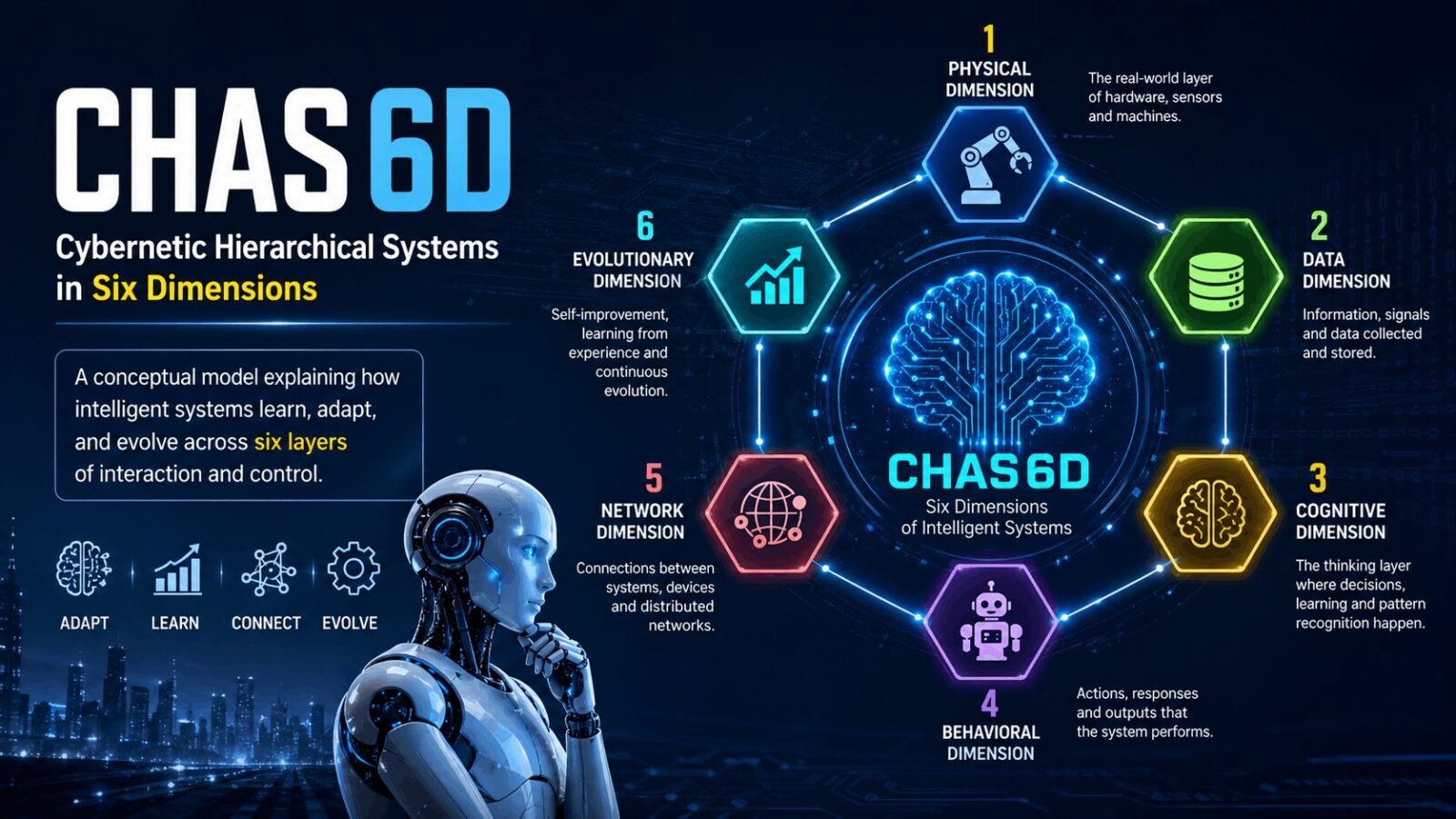
The term CHAS6D sounds very technical, and honestly it is. It stands for:
Cybernetic Hierarchical Systems in Six Dimensions
In simple words, chas6d is a conceptual mathematical model that explains how advanced AI systems, robots, and complex networks can learn, adapt, and evolve across six different layers or “dimensions” of interaction and control.
That sounds heavy, but don’t worry. We’ll break it down in a very simple, human way.
No deep math required.
What is CHAS6D?
Let’s make it easy first.
CHAS6D is a model used to understand intelligent systems that can think, adapt, and improve themselves across multiple levels of behavior and decision-making.
It is regularly mentioned in areas like:
- Artificial intelligence (AI)
- Robotics
- Complex network systems
- Machine learning theory
- Cybernetic systems
Simple explanation:
It’s a way of describing how smart systems evolve step by step in multiple “layers” instead of just one simple level.
Breaking down the CHAS6D concept
To understand it properly, let’s split the idea.
CHAS = Cybernetic Hierarchical Adaptive System
6D = Six Dimensions of interaction
So basically:
- Cybernetic = self-controlling systems (like AI)
- Hierarchical = established in stages
- Adaptive = able to analyze and exchange
- Six Dimensions = multiple layers of behavior and control
Put together, it describes a multi-layer intelligent system that improves itself over time.
What are the “Six Dimensions” in CHAS6D?
Now this is the core idea.
CHAS6D assumes that intelligent systems operate across six different layers.
Let’s simplify them:
1. Physical Dimension
This is the real-world layer:
- Hardware
- Sensors
- Machines
- Robots
Basically, the “body” of the system.
2. Data Dimension
This is where information exists:
- Input data
- Collected signals
- Stored information
Without data, nothing can be learned.
3. Cognitive Dimension
This is the thinking layer:
- Decision-making
- Pattern recognition
- Learning processes
This is where AI starts “thinking.”
4. Behavioral Dimension
This controls actions:
- Robot movements
- System responses
- Output behavior
What the system actually does.
5. Network Dimension
This connects systems together:
- Cloud systems
- Connected devices
- Distributed networks
Modern AI rarely works alone.
6. Evolutionary Dimension
This is the most advanced layer:
- Self-improvement
- Learning from experience
- System upgrades over time
This is where AI “evolves.”
Why This is important
You might be thinking… okay, but why does this matter?
Good question.
CHAS6D helps researchers understand:
- How AI becomes smarter over time
- How robots adapt to environments
- How complex systems stay stable
- How machines interact with humans and data
It’s basically a blueprint for advanced intelligent systems.
Real-world applications of CHAS6D
Even though CHAS6D is theoretical, it connects to actual technology.
1. Artificial Intelligence
Used in:
- Chatbots
- Smart assistants
- Recommendation systems
2. Robotics
Used in:
- Industrial robots
- Self-learning machines
- Autonomous systems
3. Smart networks
Used in:
- Cloud computing
- Distributed systems
- IoT devices
4. Data science systems
Used in:
- Big data analysis
- Predictive modeling
- Pattern recognition
How CHAS6D works (simple step-by-step idea)
Let’s simplify how such a system functions.
1: Data collection
The system gathers information from sensors or inputs.
2: Processing
It processes data using algorithms.
3: Decision-making
The system decides what action to take.
4: Action execution
It performs tasks or outputs results.
5: Feedback learning
It learns from results and improves.
6: Evolution
Over time, it becomes smarter and more efficient.
CHAS6D vs traditional AI models
Let’s compare it simply.
| Feature | CHAS6D Model | Traditional AI |
|---|---|---|
| Structure | Multi-layer (6D) | Limited layers |
| Adaptation | High | Medium |
| Learning ability | Continuous evolution | Fixed training cycles |
| Complexity handling | Very high | Moderate |
| System interaction | Multi-system network | Mostly single system |
So CHAS6D is more about advanced, evolving intelligence systems.
Why researchers talk about CHAS6D
It is discussed because modern systems are getting more complex.
Researchers want to understand:
- How AI can self-improve
- How machines interact across networks
- How to manage large intelligent systems
- How to create stable adaptive systems
So CHAS6D acts like a theoretical framework for future AI design.
Key features of CHAS6D systems
• Multi-layer structure
Systems work in multiple levels at once.
• Self-adaptation
They adjust based on environment.
• Continuous learning
They improve over time.
• Network interaction
They connect with other systems.
• Behavioral control
They adjust actions dynamically.
Benefits of CHAS6D model
Even though it’s theoretical, it gives useful insights:
- Higher information of AI structures
- Helps design smarter machines
- Improves system stability concepts
- Supports advanced robotics research
- Explains complex system behavior
Challenges and limitations
Of route, it’s not ideal.
1. Very complex
Hard to fully implement in real systems.
2. Mostly theoretical
Not widely used in commercial AI yet.
3. Requires high computing power
Advanced systems need strong infrastructure.
4. Difficult to test fully
Six-layer models are hard to simulate completely.
Simple analogy to understand CHAS6D
Let’s make it very easy.
Imagine a robot:
- Body = physical layer
- Brain memory = data layer
- Thinking = cognitive layer
- Actions = behavioral layer
- Internet connection = network layer
- Learning over time = evolutionary layer
That’s CHAS6D in real-life thinking.
Who studies CHAS6D concepts?
This type of model is usually studied by:
- AI researchers
- Robotics engineers
- Data scientists
- Cybernetics experts
- Academic theorists
It’s more of an advanced research topic.
Future of CHAS6D concepts
If developed further, such models could help build:
- Smarter autonomous robots
- Fully adaptive AI systems
- Self-healing networks
- Advanced decision-making machines
Basically, systems that don’t just follow commands but learn and evolve like living systems.
FAQs
1. What is CHAS6D in simple words?
It is a model that explains how intelligent systems operate across six levels of interaction and learning.
2. Is CHAS6D a real AI system?
No, it is mainly a theoretical framework used in research concepts.
3. What does 6D mean in CHAS6D?
It refers to six dimensions of system behavior, learning, and control.
4. Where is CHAS6D used?
It’s miles mainly utilized in AI concept, robotics studies, and complex system modeling.
5. Is CHAS6D difficult to understand?
Yes, but breaking it into layers makes it easier.
6. Can CHAS6D be used in real products?
Not directly yet, but parts of it influence modern AI systems.
Conclusion
CHAS6D is a deep and superior idea that describes how intelligent structures like AI and robots can characteristic throughout multiple layers of getting to know, manage, and evolution.
Even though it sounds complicated, the concept is straightforward at its core:
System grow to be smarter when they are able to learn, adapt, and improve throughout a couple of levels in preference to just one.
It’s miles nevertheless on the whole a studies-based version, however it allows us consider the future of artificial intelligence where machines don’t just follow instructions—they evolve.
And that’s where things start getting really interesting.