

Introduction
The time period soup technology might sound a little uncommon before everything. Like something associated with meals or cooking. But inside the tech world, it’s actually used as a idea to give an explanation for collaboration, shared sources, and constructing systems together in a smart way.
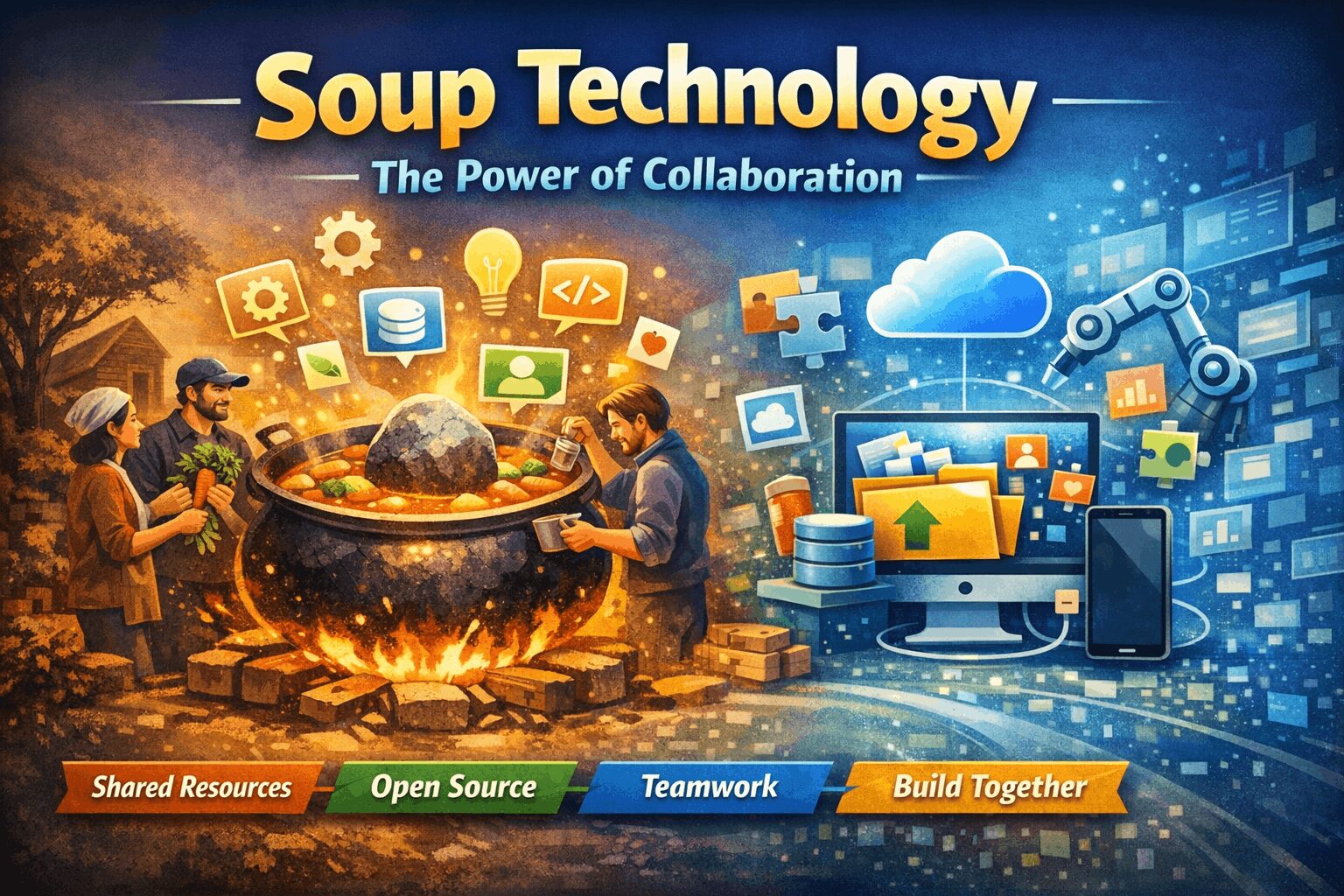
One famous concept connected with it is stone soup technology, which comes from an old people tale. In modern tech, it represents how different people or systems contribute small parts to create something powerful.
In this newsletter, we’ll destroy it down in a completely simple way so you can understand what it means, the way it works, and where it’s miles used.
What is Soup Technology?
Soup technology is not a single software or tool.
It’s far greater of a concept that describes how technology projects are built the use of shared effort, shared gear, and occasionally even shared records.
Consider it like making soup:
- One person brings vegetables
- Another brings spices
- Someone adds water and salt
- And collectively, they make a full meal
In the same way, soup technology manner exceptional participants or structures come collectively to construct some thing useful.
It’s far frequently used to provide an explanation for:
- Collaboration in tech initiatives
- Open-source development
- Network-driven innovation
- Resource sharing between systems
So instead of one company doing everything alone, many small contributions create something big.
The Meaning of Stone Soup Technology
Now permit’s speak approximately stone soup technology, because it’s miles carefully related.
This idea comes from a folk tale known as “Stone Soup”.
The story in simple words:
A visitor involves a village with not anything however a pot and a stone. He starts offevolved boiling water with the stone and claims he’s making “stone soup.”
Curious villagers start adding ingredients:
- One adds carrots
- Another adds potatoes
- Someone adds salt or meat
In the end, everybody contributes a touch, and they all percentage a big, wealthy soup.
In technology terms:
Stone soup technology means:
- A system or project starts with minimal resources
- People or teams gradually contribute tools, code, or data
- The final result becomes powerful because of collective input
It is basically the foundation of modern collaboration in tech ecosystems.
How Soup Technology Works in Real Life
Even though it sounds theoretical, soup technology is surely used in many actual-global structures.
Here’s the way it works step by step:
1: Start with a basic system
A challenge starts with a simple shape. It is probably:
- A basic app
- A small code framework
- A simple platform
Nothing advanced yet.
2: Contributors join in
Developers, users, or companies start adding value.
For example:
- One adds a feature
- Another fixes bugs
- Someone improves design
3: Shared resources are used
Instead of building everything from scratch, teams use:
- Open-source libraries
- Cloud services
- APIs
- Public datasets
4: System grows gradually
The project becomes stronger over time because of continuous input.
5: Final product becomes powerful
What started small becomes a complete system used by many people.
That is soup technology in action.
Key Features of Soup Technology
Soup technology is known for a few important characteristics:
1. Collaboration
Everything is built together, not alone.
2. Resource sharing
People contribute small parts instead of full systems.
3. Scalability
Projects grow over time without starting from scratch.
4. Community-driven
Users and developers both play a role.
5. Flexibility
Systems can adapt easily as new contributions come in.
Benefits of Soup Technology
There are many advantages to this approach.
1. Faster development
Because multiple people contribute, things move quickly.
2. Lower cost
You don’t need to build everything yourself.
3. Innovation increases
Different ideas come together, creating better solutions.
4. Strong communities
Users feel part of the project.
5. Better problem solving
Many minds solve problems faster than one.
Real-World Examples of Soup Technology
Even though the term isn’t always continually used without delay, the idea is anywhere.
1. Open-source software
Projects like Linux or WordPress are constructed by using lots of contributors.
2. App development platforms
Developers use shared APIs and tools to build apps faster.
3. Cloud computing systems
Services like AWS or Google Cloud rely on shared infrastructure.
4. AI development
AI models improve because of massive shared datasets and research.
All of these follow the same idea: small inputs → big system.
Challenges of Soup Technology
Of course, it’s not perfect. There are some problems too.
1. Lack of control
When many people contribute, it can become hard to manage.
2. Quality issues
Not all contributions are good or consistent.
3. Security risks
Open systems can sometimes be vulnerable.
4. Coordination problems
Managing large communities is not easy.
5. Dependency issues
Sometimes systems depend too much on external contributors.
So while soup technology is powerful, it needs proper structure.
How to Apply Soup Technology in Projects
If you are a developer, startup owner, or even a content creator, you can use this idea.
Here’s how:
1: Start simple
Don’t overbuild inside the starting. Keep it minimum.
2: Encourage contributions
Allow others to:
- Suggest features
- Improve content
- Fix issues
3: Use open tools
Work with:
- Open-source frameworks
- Public APIs
- Shared databases
4: Build a community
Create space where people can participate without difficulty.
5: Keep improving
Update and grow based on feedback.
That’s basically the modern version of stone soup technology.
Why This Matters in 2026
In today’s world, no system grows alone.
Everything is connected:
- Apps depend on APIs
- Websites depend on cloud services
- AI depends on shared data
- Developers depend on open-source tools
So soup technology is not just an idea—it’s how modern tech actually works.
It supports:
- Faster innovation
- Global collaboration
- Shared success models
Future of It
Looking ahead, this idea turns into even more vital.
We can expect:
- More open-source ecosystems
- AI systems trained on shared models
- Decentralized platforms
- Community-owned digital products
Basically, the future of tech will rely even more on shared effort.
FAQs
1. What is soup technology in simple words?
It is a concept where technology is built through shared effort, resources, and collaboration.
2. What is stone soup technology?
It comes from a people story in which small contributions from many people create a complete meal. In tech, it way building systems collectively little by little.
3. Is soup technology a real software?
No, it isn’t a software program. It’s far a concept used in generation and improvement.
4. Where is soup technology used?
It is utilized in open-source improvement, cloud systems, AI projects, and collaborative systems.
5. Why is soup technology important?
As it lets in quicker development, lower fee, and higher innovation through teamwork.
Conclusion
Soup technology is a simple however powerful idea. It shows how small contributions from different people or systems can create something much bigger.
The idea of stone soup technology explains it perfectly—when everyone adds a little, the result becomes something valuable for all.
In today’s digital world, this approach is everywhere. From apps to AI systems, almost everything is built using shared effort.
So even though the name sounds simple, the impact of soup technology is actually huge—and it will only grow in the future.